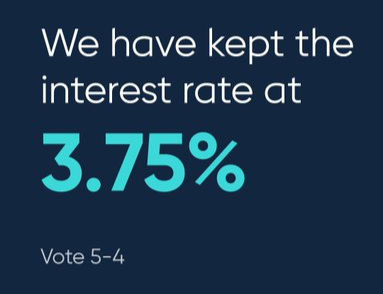
NEWS: BOE HOLDS BENCHMARK RATE AT 3.75%
- Mar 19
- 3 min read
Updated: Mar 24
WAR TRUMPS DOVE CUTS. BANK OF ENGLAND BENCHMARK RATE HELD AT 3.75%
On 19/03/2026 The Bank of England (BOE) held its benchmark base rate at 3.75% with a unanimous 9-0 vote. The BOE had been expected to continue with its rate cuts but blamed the U-Turn on the recent military conflict in the middle-east rather than the UK's benighted Energy Profits Levy.

MARKET REACTION:
GBP/USD: Immediately following the announcement sterling jumped 0.28% reaching $1.3356 at the high.
10-year Gilts: Spiked on the BOE announcement. Yields jumped to 5%, the highest since 2008.
Traders: At the beginning of the year traders expected the BoE to cut rates twice. Now they see 2 rate rises to 4.25% and an 80% chance of a third to 4.5%.
Next Rate Decision: 30th April 2026.
The BOE's Monetary Policy Committee (MCP) meets 8 times per year to consider the benchmark base rate. Thereafter, it publishes its MCP minutes those arising from 19/03/2026 you can read by click here.
BOE HAWKS SWOOP IN ON USA/ISRAEL CONFLICT
on 28/02/2026 the USA & Israel launched their long awaited military strikes on Iran hitting Iranian nuclear and military sites. The allies scored an early victory in the first wave with the death of the Iranian Supreme Leader Ayatollah Khamenei and thereafter most the leadership contenders. Effectively, cutting the heads off the hydra and sealing Iran's wounds with fire. In response, Iran launched waves of missile and drone strikes on their neutral neighbours attacking hotels, oil refineries, gas fields, desalination plants and attempting to close the strait of Hormuz with only 90 tankers getting through since the start of the conflict. That is 20% of the world's oil and gas choked.
The recent MCP minutes indicate that but for the conflict the BoE would have narrowly voted 5-4 to cut interest rates to 3.5% on Thursday. However, the war is seen as inflationary with the BoE expecting consumer-price growth to hold steady at 3% in the second quarter of the year as petrol prices rise rather than revert back to 2% as previously thought. Their leading concern however, would seem to be energy and In their statement the MCP blamed:
Conflict in the Middle East has caused a significant increase in global energy and other commodity prices, which will affect households' fuel and utility prices and have indirect effects via businesses' costs. Prior to this, there had been continued disinflation in domestic prices and wages. CPI inflation will be higher in the near terms as a result of the new shock to the economy.
Taking its lead from the BOE the European Central Bank (the ECB) held its rates at 2% citing uncertainty and concerns about an inflation shock. The US Federal Reserve yesterday had already kept its rates steady.
COMMENT
Absolute Banker Balderdash. Energy prices are spiraling because the UK has no credible energy policy.
The UK contributes <1% of global greenhouse gas emissions while sitting next to some of the largest oil and gas reserves in the world. The North East of England suffers from chronic unemployment and a multitude of social ills arising therefrom, all of which contribute to higher taxes and inflation while stifling growth. Yet since 2022 energy companies have been fleeing the North East not because of the morbid weather, but the Torie brainchild Energy Profits Levy (EPL) which the effete Labour Government has since increased to 38%. Harbour Energy the UK's largest oil and gas producer is now significantly reducing its UK footprint to the point of an almost full retreat to Norway. This was after the windfall tax reportedly reached 111%in 2025. Likewise TotalGas has been divesting from the UK while Ineos Energy announced it would end all its £3 Billion North Sea investment.
While deliberately driving away energy companies does successfully increase energy costs, unemployment, inflation, crime etc; it does nothing 'to save the planet.' Instead of drilling in the North Sea i.e. on its doorstep, the UK imports its energy from halfway across the globe, which has been drilled by someone else, Consequently, the net result is just increased pollution due to the transport cost, increased cost on the household and unemployment. As for the North Sea, the UK's neighbours are drilling the exact same oil and gas reserves. Absolutely nothing is saved anywhere.
Should His Majesty's Government ever wish to reduce energy inflation it should significantly cut (if not ideally scrap) the EPL and then announce at least a 20 year freeze so investors have confidence they can make a profit. Energy for business in the UK is obscenely high. The opposite can only result cause increased employment, increased spending and reduced inflation.
As for the closure of Homurz, countries whom have the ability yet lack the will to get off their ass just embarrass themselves by winging from the sidelines.