


CROWN KILLS MAGNA CARTA - JURY TRIALS TO BE CUT
Updated: Aug 30
"NO FREE MAN SHALL BE PUNISHED EXCEPT BY THE LAWFUL JUDGEMENT OF HIS PEERS"
(Magna Carta. Clause 39)
10/03/26 the Courts & Tribunals Bill passed its 2nd reading 312-245 threatening the right to trial by jury. Should the Bill become law, the Crown arresting, charging, prosecuting will soon again have the power to judge and jail its subjects without check. The Bill erases 812 years of civil progress and reverts the justice system back to the age of the incompetent King John Plantagent.

This comprehensive but concise article concerns the trojan landmark 'Courts & Tribunal Bill' aka 'the Anti-Juries Bill.' At the time publication this has just passed its 2nd reading and seeks to reverse 812 years of civil progress ending 'trial by peers.' This restores the states powers to arrest, charge, prosecute and in-prison without civilian oversight.
The article begins by providing links directly to the Bill itself together with explanatory notes and bullet points the major changes. It provides the context in the form of a drop-down Q&A before looking at the history of liberties being abolished. It concludes with a mission statement and promise of things to come.
THE COURTS & TRIBUNAL BILL
His Majesty's Government (HMGs) Courts & Tribunal Bill which read by clicking here:
Removes a defendant's right to elect jury trial for "either-way" offences (mid-level crimes like theft and assault).
Allows judge-Only trials in Crown Court for cases likely under 3 years' jail, or "complex/long" ones such as fraud or bribery (which frequently involve the police).
Increases magistrates powers to imprison up to 18 - 24 months custody from the current 12.
Ends automatic appeal from magistrates. Defendants now need permissions, removing the key safety net from judgement and bias of legally untrained state volunteers (whom nearly always just convict).
HMG explanatory notes can be accessed by clicking here.
Parliament's own webpage concerning the Bill can be accessed by clicking here.
WHY ARE JURIES IMPORTANT?
To be blunt this nation cannot afford to lose juries due to the social cost and for the wrongly accused its a matter of life and death. Simply put we argue, it is a question of' justice 'the purest form of efficiency.
UK social security spending 25/26: The UK Budget is £1.37 TRN. However, tax receipts were only £1.22 TRN. This means the Crown has increased the national debt again and while growth is currently 0%. A breakdown is below but the figures we should keep in mind are Welfare: £333 BN, Debt Interest £113.7 BN, Justice £15 BN and Housing £13.6 BN.
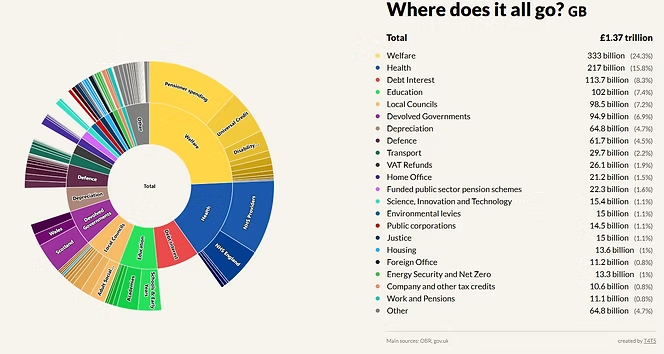
This chart was pulled from a third party site which can be accessed by clicking here.
Now consider the affect of a criminal conviction:
Employment: The data confirms 1-5 UK adults and 25% of UK male adults have a criminal conviction. That is 9-12 million people yet UK unemployment hovers at 4.2%. Regretfully 50% - 75% of employers automatically reject applicants with a criminal conviction (unspent or not). The charity 'Unlock' which campaigns to keep confidential all but the most serious criminal convictions places the figure as high as 75%. We would suggest the latter figures is more likely correct as firms frequently inflate their social inclusion policies and find other reasons to reject worthy candidates. For these candidates whom have served their sentences, there are employers whom sign up to a 'Ban the Box' campaign i.e. they will not ask about convictions. These are almost entirely, low skilled admin, physical labour or zero-hour contracts. For any professional positions such a law, accountancy, finance or business consultancy the chances of being accepted are almost 0.
Prisoner Post-Release Employment: In May 2024 March 2025, about 20.1% of offenders were employed at 6 weeks after custody (excluding those unavailable for work, Probation reset cases, or unknown status). That is an increase from 19.3% in the year to March 2024. At 6 months, 34.5% an increase from 31.1%. For longer sentences >12 months, it is 37.8%. Approximately 83% of people with convictions struggle to land a job within 1 year of release - meaning only about 17% succeeded early on.
Prisoner Re-offending: Employment cuts re-offending by approximately 9%. For prison leavers those in work 6 weeks after release the re-offend rate stand at 17% vs 35% for the jobless. In general; unemployed ex-prisoners are twice as likely to be recalled and that does not account for negligence of the probation services which should carry its own criminal punishments (but do not for self-serving policy reasons).
Conviction Rates in the Magistrates Court: Magistrates’ courts (no jury—three lay magistrates or district judge):
Handle 90-95% of criminal cases (minor stuff like theft, assault).
Conviction rate: Around 84% overall (from older data; CPS overall 83.1% in 2024/25, but magistrates skew higher ’cause more guilty pleas—62% in Q3 2025).
Why higher? Less serious charges, quicker pleas, no jury doubt. Ineffective trials ~23% (cracked or rescheduled).
Conviction Rates in the Crown Court: (serious crimes—murder, rape, robbery and of course 'assault on an emergency worker):
Only 5-10% of cases go here; of those, 20-25% plead not guilty and get jury (rest guilty pleas).
Conviction rate: Lower—around 78-80% in contested trials (from forum posts/Hacker News citing MoJ; CPS overall 83%, but Crown drags it down). Jury acquits more ’cause “reasonable doubt” hits harder.
Ineffective trials ~25% (higher backlog).
Judge-only trials (judge decides guilt—no jury):
Rare—pilots for rape/sex cases or fraud. No big UK stats yet (2025 reforms just proposed, not rolled out).
From studies (e.g., rape cases): Judges convict at higher rates than juries—up to 10-15% more in some analyses (like Scotland pilots or old English data). One 2025 Telegraph report: judges “more lenient” in sentencing but potentially stricter on guilt (jury myths lower convictions).
Estimated 20% faster than jury, but “marginal” backlog fix (<2% time saved). No direct 2025 conviction %—too new.
Bottom line: Juries acquit more (lower conviction) but this does not mean they are inefficent. Drawing from our own cases involving the police:
Devon & Cornwall police refused to investigate a builder whom turned a building into a bomb; had the explosion gone off it would have taken out the trainline behind, killed the family in the semi-detached house next door and the only reason this did not was because E.ON had disconnected the gas 3 days before. BUT;
A concussed man allegedly brushed the shoulder of a police officer while walking past and was charged. He was arrested/attacked by 5 police officers, pepper-sprayed, tied up and had his head bashed against multiple surfaces, causing severe injury. The police then charged their victim with 'assaulting an emergency worker' This case had to to go to the Crown for trial by jury as there was no prospect any of the officers would dare face a jury. The charges were dropped as soon as the man elected trial by jury
DATA RELIED UPON?
Stats: Main publication page (overview & downloads):
https://www.gov.uk/government/statistics/offender-employment-outcomes-update-to-march-2025
Direct Excel downloads (tables):
• Employment at 6 weeks post-release: https://assets.publishing.service.gov.uk/media/688a41748b3a37b63e7390a0/Employment_at_6_weeks_post_release.xlsx (This has Table 2a-ish breakdowns—your 20.1% for May 2024–March 2025 is here, excluding unavailable/unknown.)
• Employment at 6 months post-release: https://assets.publishing.service.gov.uk/media/688a4189e1a850d72c40927d/Employment_at_6_months_post_release.xlsx (34.5% overall for supervised cases—rising trend.)
Statistical guidance (how they measure, exclusions):
THE POLICE FORCE
While the Crown is failing to deliver any type of growth, defend territory but increasing the tax burden, it should be noted that the official data also confirms its police force has fallen to disarray:
UK police complaints and public trust (England & Wales focus, up to late 2025/early 2026). Pulled from IOPC, MoJ, ONS, and Gallup: Complaints against police (2024/25, year ending March 2025):
Total complaints logged: 94,940—up 11% from the previous year. Record high, per IOPC report.
Total allegations: 168,249 (multiple per complaint).
Recordable conduct matters (serious, investigated under Schedule 3): 32,172.
Outcomes: Most handled informally—95% of non-Schedule 3 allegations resolved; under Schedule 3, 80% not investigated, 20% were (with low upheld rates). Overall, “service acceptable” in 67% of cases; “not acceptable” in 13%.
Misconduct finalised: 15,843 allegations across 7,108 cases—up 20% from prior year. 1,687 officers referred to proceedings (1.1% of workforce), 695 dismissed (0.4%). Trend: Rising due to bigger force (Uplift Programme), public scrutiny (post-Casey/Angiolini reports), better reporting.
As for Public trust/confidence (latest 2025), these figures would seem high:
ONS (year ending March 2025): 67% confident in local police—slight uptick from 65% last year, but down from 76% a decade ago.
Positive rating of police performance: 49% “good/excellent”—flat year-on-year, but crashed from 62% in 2015.
Gallup (2025 full-year): Confidence in local police dropped 11 points to 64%—biggest annual fall ever. Tied to overwork, victim support fails, scandals. Courts fell harder (to 57%). Gap widened by politics: 27-point difference between gov approvers/disapprovers.
Broader: Victim satisfaction with police handling: 51%—down from 70% in 2015. Visibility (foot patrols): 11% weekly—way off 2011 peak of 39%.
With the removal of juries providing civilian oversight of a police force that is not fit for purpose together with a judiciary that has its own bias, the risk is in 50 - 60% of cases that the police force will accuse whomever they want of whenever they want, that person will be put on trial essentially behind closed door, convicted and then become dependent on the state which costs the rest of us. Any person with integrity in those situations wil be tempted to self-harm and should you be in such a situation, please seek help. You can find contact details for people whom can help behind the Resources section of our website.
DATA RELIED UPON
Our main sources are as follows:
CONTEXT & BACKGROUND
WHAT DOES THE BILL AIM TO ACHIEVE AND WHY?
Not abolition of juries just 'tweaks' with pilots to be trialed first.
The Crown Court currently has a backlog of >80'000 cases. People wait years for trials.
HMG argues that juries slow the process. Allege jury trials are 3-5 days longer than a judge-only trials would be.
Complex cases such as fraud and bribery confuse juries. Judges allegedly handle evidence better [balderdash!].
Low level either-way offences do not need 12 'strangers'. Judges alone speeds them up.
Saves £millions in court time, frees judges for allegedly harder case.
Victims would allegedly get closure faster - no [mythical] endless waits.
"This is about justice that is fit for today. Not yesterday. Backlogg isn't a luxury its a crisis." (Lord Chancellor & Justice Secretary Rt Honourable David Lammy MP)
WHAT HAS CAUSED THE CROWN COURT BACKCLOGG?
Covid and the Emergency Workers Act 2018 (the Act) created a perfect storm resulting in the collapse of the English criminal justice system. The latter was passed November 2018 and was sold to the public as a means of protecting front line emergency-worker staff such as nurses and ambulance staff from attacks. This was allegedly to be achieved by making any assault on their person a stand alone offence. In reality, it was used by the crown to empower and excuse the police from committing increased brutality. Specifically, prior to the Act; should a police officer lay their hands on a civilian/subject illegally; that person was allowed to use proportionate force to resist. But now: if 4 police officers attacked a man with a concussion for no reason, the concussed man would be allowed to push back. With the passing of the Act the concussed man lost that right and was automatically be charged with offence on an assault on an emergency worker.
Real life example of the Emergency Workers Act 2018 in action:
The police were not injured. They had allegedly mistaken a concussed man whom had been attacked while walking home for being drunk and in doing so had bashed his already injured head against a wall multiple times. The man kept repeating robotically that he was just going home (he did not know what town he was in but he was able to walk almost on auto-pilot). For a whole 40 minutes, the police kept gabbing him pushing him against other surfaces causing further shock and injury. He was eventually surrounded and when he walked past an officer, they decided to arrest him for assaulting an emergency worker. It was alleged that he had brushed the shoulder of one. The concussed man then had his head again bashed against a police van, was pepper sprayed, tied up and suffered even further injury while his head was bashed repeatedly inside the van as he rolled about and he lost consciousness several times. On being taken out of the van, the man was now unable to stand or look at any light whatsoever. Despite this, the police shook him violently and what he recalled vividly through the light, was their laughter. He was then thrown him in cell which had a suspicious puddle. He was kept awake the entire night as the police attempted to interview him several times without legal representation but he was at the time unable to answer anything. Hours later when his wits slowly began to return he realised where he was and requested a solicitor. He was then discharged from a station in a different town where he wandered the countryside injuring himself further.
The police (not the CPS) charged the man with assaulting an emergency worker which cut his income. He was then forced to use what little was left of his money defending himself while looking after 2 elderly dependents. Because of his past earnings, no state aid was provided. During this time, while the affects of his brain injury became more apparent i.e. random memory loss, fits, muscle spasms etc, the exact officers involved from Thames Valley police attended his property to have a good laugh. All they did here was try to get information out of him such as how he would be defending himself.
The man elected for trial by Jury which necessitated Crown Prosecution Service (CPS) involvement. At the first hearing; the CPS asked for time to speak to the officers, whom while very brazenly enjoyed attending the brain damaged man's house, never once had the courage to attend court. Charges were withdrawn promptly but the man never recovered his funds and the Thames Valley Police officers never faced any disciplinary action. This was partially because the concussed man had been advised to apologies to the plods which he reluctantly did due to the lack of funds and 2 elderly dependents. In a final act of Crown-cronyism, HHJ Nawaz defended the police robustly when discharging the man reluctantly.
Since the passing of the Emergency Workers Act 2018, prosecutions spiked from 17'000 - 22'000 in 2021 alone and then kept rising. Examples such as the above, once unthinkable now happen every day in England & Wales. On passing the Act, the Crown seemed to expect that the lower sentencing powers of magistrates would tempt innocent people (many of whom would automatically lose their jobs once charged and be too starved of funds to defend themselves) into just pleading guilty to the offence. However, they underestimated the publics will to resist and the vast majority demanded the trial be transferred to the crown for trial by jury/their peers i.e. in a conflict between the civilian and the state; civilians would have the final say. This together with the incompetence of the executive in borrowing from the markets to fund just about everything conceivable save for the courts (and armed forces) caused the criminal justice system to essentially collapsed.
WHAT ARE THE NEXT STEPS AFTER SECOND READING?
At the time of publication, there are no specific dates:
House of Common Committee Stage: line-by-line scrutiny - amendments and debates. This could technically start next week.
House of Commons Report Stage: Whole House reviews committee changes - more amendments.
House of Commons Third Reading: Final vote - In practice this a rubber stamp before sending it to the House of Lords [so called].
House of Lords First Reading: This is a formal introduction.
House of Lords: Second Reading. The Lords debate the Bill but do not vote.
House of Lords Committee: This is a very detailed scrutiny often in a Grand Committee.
House of Lords Third Readings: The Lords tweak the Bill and have a history of practically re-writing some controversial bills.
House Ping-Pong: The Commons considered the Lords suggestions and the Bill is Ping-Ponged until a final draft is agreed. The Commons have had the power to overrule the House of Lord in the Parliament Act 1911.
Royal Ascent: King Charles III considers.
812 YEARS OF CIVIL ADVANCEMENT
1214 Battle of Bouvines: The incompetence of the Crown leads to defeat and the loss of Normandy, Anjou, Maine Touraine and Brittany. The English Barons revolt.
1215: Magna Carta: The Great Charter, mother of all western constitutions is sealed at Runnymede. Rebellious Barons force the Crown to submit to trial by peers. King John defeated in a series of a battles.
1225: Henry III re-issues Magna Carta as enforceable law. The 'Judgement by Peers' becomes enforceable law.
1297: Edward I enforces Magna Carta right to jury as law. Judgement by Peers becomes 12 ordinary citizens.
1351 Edward III Statute of Westminster adds due process to Manga Carta. Juries become standard for felonies - fair hearings guaranteed, no royal shortcuts to custody, seizure or death.
1679 Habeas Corpus Act: Reinforces jury trials to protect against unlawful detention. The Crown cannot jail its citizens without the jury's say-so.
1689 Bill of Rights: The right to trial by jury confirmed for cases of treason! Crowns powers curbed again with the end of "cruel punishments" in secret.
1825 Jurys Act: Standardises twelve-person juries, drops property qualifications. The 'common man's rights are enforced and protected. No more 'justice for the elites only.'
1949 Jurys Act: All property qualifications removed. Everyone is now eligible to sit and judge their peers. The wealth barrier is removed and access to justice flourishes.
2003 Criminal Justice Act: The Crown attacks Magna Carta rights and the shield wobbles. Judge only trials for complex fraud piloted but never fully used.
10/03/2026: The Crown finally succeeds in abolishing the sacrosant principle of 'trial by peers' and Magna Carta shield is shattered. England & Wales are to be used as a guinea pig for what is essentially a debt-ridden police state while civil liberties remain in Scotland and Northen Ireland.
What this timeline shows is that civil liberties were advanced when the nation was growing and now that is stagnating, the Crown is taking them back.
COMMENT
The Hexagon of our logo is a shield representing the defence of the subject against the incompetence of the executive be it the crown, agent or any benighted form of authority. The rising colour pigmentation represents the growing force of will that advances these liberties. The faded top reminds us that the work of the law in the protection of the defenceless is never complete and guards against complacency. While our shield remains this fight is far from over.


